Dispatch

DISPATCH · A WORK ASSISTANT IN DAILY USE

Do the work.
The record writes itself.

Doing the work and writing it down have always been two jobs, so the second one never happens. Dispatch takes one line in the words you already use, lands it on the right task and works out the dates and the order. Work done with a coding agent becomes a progress log without you saying anything.

Every figure here was measured on a running installation · Mycelium sits alongside it

FRONT AND CENTRE

Dispatch — the assistant that removes the writing-down

DISPATCH · WORK ASSISTANT

Send one line.
It lands on the right task.

There is no shortage of task managers. What is left over is choosing which item to write it under, and because that judgment falls to a person, nobody writes anything. Dispatch took the choosing away.

Team messenger · 4:12 pm

Sending the brochure draft by tomorrow afternoon

Product brochure revision

Due Sep 15 (Tue)In progress

Next action

Send the brochure draft

Progress log

Sending the brochure draft by tomorrow afternoon

No task was picked, no date was counted. The assistant finds the matching one among the open tasks — it asks back only when two or more have similar names.

A folder linked to a task · commit pushed

Nothing was reported

Kanban board improvements

Progress log that evening · recorded automatically

[commit] card drag-and-drop · 6 tests added

Link a task to the folder you worked in with Claude Code or Codex, and the commits made there become the progress log that evening. It does not care which tool made them.

The task list lives as md files, and the issue tracker keeps receiving your weekly hours as before.

Dates, order and capacity are worked out in code, so the answer is the same every time. The model is used once, only to read the sentence, and one task is one md file — it still opens after you delete this tool.

Dispatch in depth →
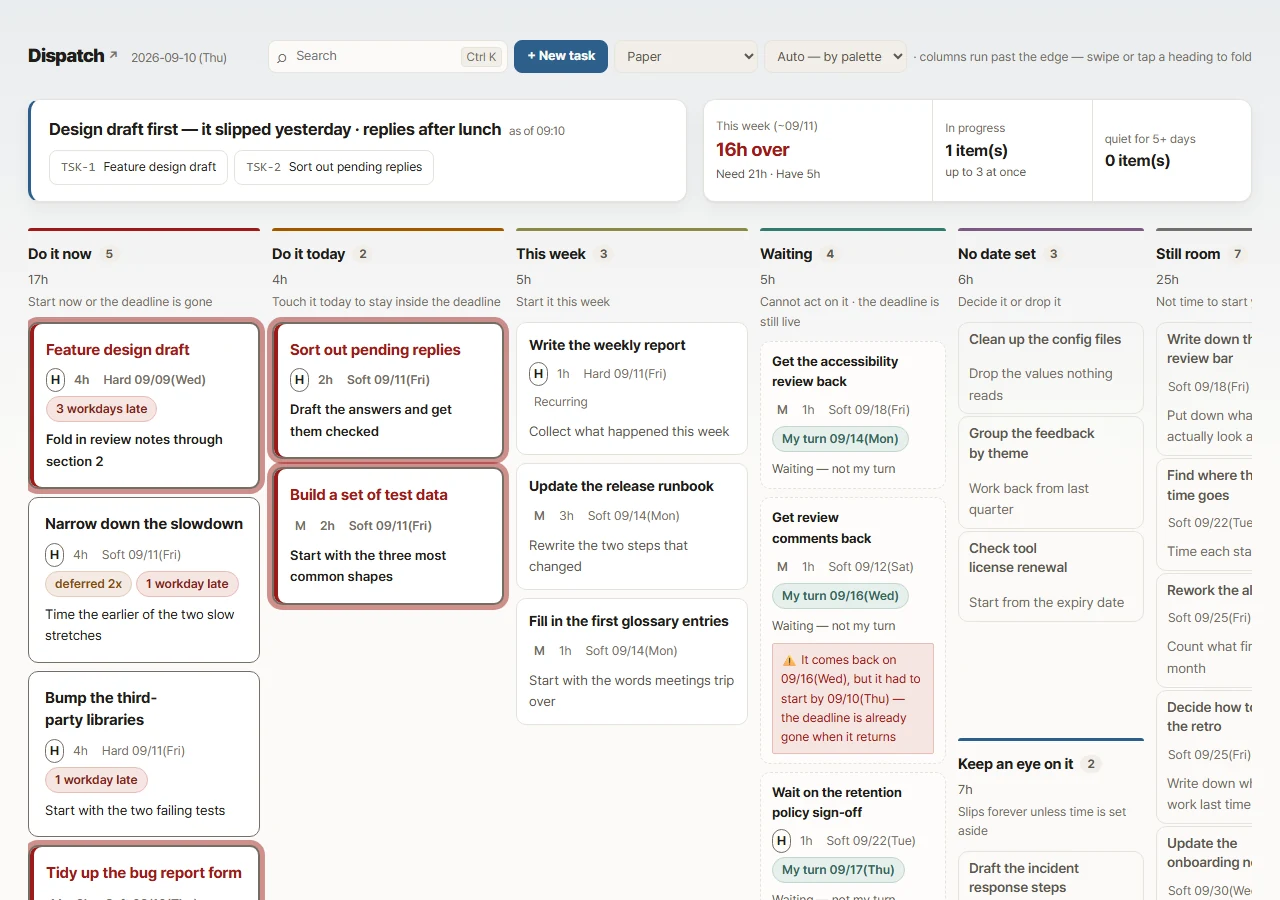
A kanban board split into seven columns, urgent ones on the left, with a red outline on the cards that need work today
95.0%accuracy spotting work in mail
3.3sphone tap to board update
$30/mowhat the model costs

OTHER SOLUTIONS

Built the same way, for a different problem

The problem differs; the rules do not — no model where there is nothing to judge, and a person approves anything that leaves the building.

MYCELIUM · INTERNAL KNOWLEDGE BASE

Connects scattered company material and answers in one line

Company material is scattered across work mail, an issue tracker, a document tool, code review, file servers and more, each with a search box that only sees itself, and commercial AI search has none of this data and stays generic. Mycelium pulls that material into one index and builds a graph of how people, projects, issues and documents connect, so a question no single tool could answer comes back as one reply with its sources.

Where you use it
Work chat and the terminal — no new screen to open
Done for you
Indexed every night before dawn, taking only what is new · routed to search by meaning, by relationship, by counting and filtering, or by exact token
What you can see
Collected under your own account — your own material is connected in too, and only when you search
Deliberately out
Inventing an answer — when nothing is found it says not confirmed within the search scope
In technical terms
Hybrid retrieval over a knowledge graph — vector, full-text, SQL aggregation and graph traversal, chosen by query routing
Mycelium in depth →

"Who fixed PROJ-1234?"

By exact token (FTS5) → by relationship (KG)

Who fixed it, what they raised, and the sources, in one reply

"What is the travel expense policy?"

By meaning (vector)

Points to the clause in the company policy held in the groupware

98.1%accuracy on a regression set grown from real questions
4–12squestion to answer at 50k documents
eightsource types connected so far — more can be added

Where Dispatch and Mycelium meet

One turns the work you are doing into a record; the other pulls answers back out of the records that piled up. They are the front and the back of the same flow.

the work records one answer Dispatch Mycelium

SIDE BY SIDE

Dispatch and Mycelium handle different time

Both remove work a person was doing by hand while moving between tools. What tells them apart is which direction in time they face.

Dispatch and Mycelium on the same axes · as of 2026-09-03
AxisDispatchMycelium
FacesThe work happening nowEverything already piled up
Manual step removedWriting up what you didOpening and merging scattered sources
What you doDrop one lineAsk one line
What comes backWhat to start todayOne answer, with its sources
SurfaceA single board — same view on phone and desktopNo screen — one command and work chat
Where the model is usedUnderstanding a sentence, judgement — $30 a monthMeaning search, relation extraction — about $15 a month ($0.5 a day)
Where it runsCloud, on-premises or a local server — the store stays where you install itCloud, on-premises or a local server — the store stays where you install it

WHAT BOTH BUILDS TAUGHT US

Four rules that transfer to any team

Two different problems, and the rules left over are the same ones. They are about method, not about these tools, so they travel.

MEASURED

Every figure here came from
an installation in daily use

Nothing was produced for a demo. Each figure carries what was measured and when.

When material grows past a measurement date, the old figure stays until it is measured again. Scale differs from site to site, so per-installation counts are never used as figures.

The fastest way in is to click something

The demo is drawn by the real code. Only the tasks are made up — the cards actually move.

Contact

Ask us anything

Adoption, a demo, how it was built — whatever is useful to you.

Reply
Sent to the e-mail address you leave
What you write
Used only to reply · never passed on
See it first
Open the demo →